Authentic Intelligence: A Manifesto for Mid-Market Leaders Building With AI
Most AI consultancies sell mid-market companies the same playbook they sell the Fortune 500. The result is wasted budgets and broken trust. Authentic Intelligence is a different approach — AI strategy grounded in your actual business, not vendor templates.
I've sat in a version of this boardroom more than once. A mid-sized manufacturer. A Big Four consultancy. An eighteen-month transformation plan with a seven-figure price tag. Slides that are beautiful. Numbers that are ambitious. A timeline that everyone privately doubts.
The CTO leans over and asks, quietly, "Do you think they'll actually do this, or just sell us a methodology and leave?"
He already knows the answer. So does the consultant. So does everyone in the room, including the executives who will sign the contract anyway — because the alternative is admitting they don't know what to do, and that's the one thing they can't say out loud.
This is how AI fails at mid-market scale. Not because the technology doesn't work. Because the people making the decisions never had the right conditions to think them through.
I've spent nearly two decades inside Fortune 500 companies — IBM, Zeiss, Medtronic, Emerson — building technology at scale, with the last several years focused specifically on AI and machine learning leadership. My first project was in 2007, on IBM's BlueGene supercomputer program, as an ASIC design engineer and project manager. That early grounding in hardware and systems engineering shapes how I think about AI today: it's not magic, it's engineering. The same discipline that builds reliable chips builds reliable AI.
I've seen what works. I've also seen what fails, and the failures all rhyme.
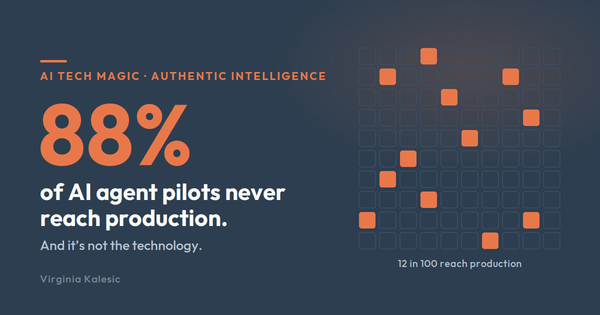
A company commits to AI because their competitors are talking about it. They bring in a consultancy that sells them a transformation narrative. The consultancy delivers a roadmap. The internal team is told to execute. Eighteen months later, the project has produced a dashboard nobody uses, a model that drifted in production, and an executive team that quietly stopped mentioning AI in board meetings.
The autopsy always blames the technology. "The model wasn't accurate enough. The data was messier than we thought. The vendor over-promised."
These are symptoms. The cause is upstream.
The cause is that organizations are automating broken processes, hiring outside consultants to avoid having to trust their own teams, and making decisions of consequence in the gaps between Slack notifications. You can't fix that with a better model. You fix it by getting the conditions right first — and then bringing the technology in.
I started AI Tech Magic to do that work for mid-market companies. Not because mid-market companies are easier than Fortune 500. Because they're underserved, and they deserve better than the choice between a Big Four contract they can't afford and a DIY approach that wastes a year.
Process before technology
When I tell executives "process before technology," they nod politely, and then they explain the AI initiative they want to launch next quarter.
So let me say it more directly. If you don't understand exactly how your business currently does the thing you want AI to help with — every step, every handoff, every edge case, every workaround your people have built around the official process — then AI will not help you. It will automate the dysfunction faster, and you'll mistake the speed for progress.
I learned this the hard way at scale. A manufacturing line that runs a documented process is a candidate for automation. A manufacturing line where everyone says they follow the process but actually relies on the tribal knowledge of three people who've been there twenty years is a trap. Automate the documented version and you'll lose the tribal knowledge. Automate the actual version and you'll discover it was never really a process — it was a system of mutual workarounds held together by relationships.
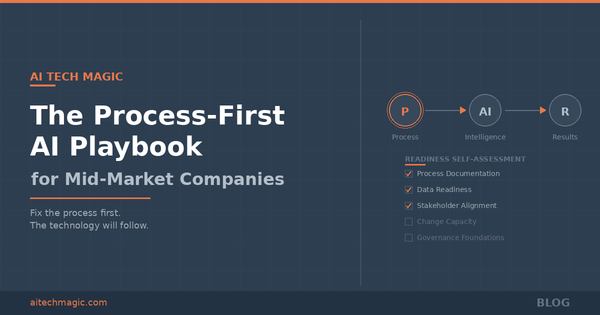
The honest first question of any AI initiative is not "What model do we use?" It's "Do we actually know how this works today?" If the answer is no — and it usually is — that's the work to do first. Map the real process. Talk to the people who hold the tribal knowledge. Document what's actually happening, not what the org chart says is happening. Then, and only then, ask where AI can help.
This sequencing is unglamorous. It doesn't make for a good slide. It's the difference between AI initiatives that work and AI initiatives that don't.
Authentic Intelligence
There's a phrase I keep coming back to: I don't think any intelligence is artificial.
Even as AI systems grow more capable — and they will grow more capable, eventually surpassing human performance in domains we can't yet predict — the intelligence inside them isn't fabricated. It comes from somewhere. From the structure of language, from patterns embedded in nature, from sources that thinkers across cultures and centuries have given different names. What we've called artificial intelligence is, more accurately, a way of accessing intelligence that was already present — in our writing, in our world, in whatever larger patterns shape both.
Calling it "artificial" lets us pretend it belongs only to us. Treating it as real, as connected to something larger than the engineering team that built it, is what makes us approach it with appropriate care.
This is what Authentic Intelligence means at AI Tech Magic. AI strategy that's grounded in your actual processes, your actual people, your actual constraints. Not borrowed playbooks. Not whatever's trending on LinkedIn this month. Not a transformation narrative scaled down from a Fortune 500 case study that has no business being applied to a 600-person company.
What it requires from you, as a leader: honesty about where you actually are. Not where you want investors to think you are, not where you've been promising the board you'd be by Q4. Where you actually stand on data quality, on team capability, on governance maturity, on the readiness of your processes to be augmented by AI.
And this is the part most consultants skip — what it requires from you also includes trusting your own team. The people inside your organization know things about your business that no outside expert can replicate in three months of discovery sessions. Most failed AI initiatives I've seen weren't failures of strategy. They were failures of trust — leadership hiring an outside firm to make a decision the internal team was already prepared to make better, because making it themselves felt risky.
So before any AI engagement, there's a question I now ask first: do you trust your own team? And if not, why not? Because if the answer is no — if you're considering bringing in outside help because internal trust has broken down — then AI consulting is the wrong tool. You need to address the trust gap first, or any strategy I help you build will fail on the same lines your previous initiatives failed on. Hiring an outside consultant doesn't replace the work of trusting the people you've already hired. Sometimes the right answer is rebuilding internal capability, not augmenting it with external expertise.
Authentic Intelligence isn't a methodology you buy. It's a way of approaching AI decisions that starts with the truth about your own organization.
What AI Tech Magic does
The work happens across three connected pillars.
AI — Authentic Intelligence. Strategy and frameworks for mid-market organizations building with AI. The work draws on proprietary frameworks I've developed across years of practice — RAPID (Readiness, Architecture, Process, Implementation, Delivery) and the Organizational Second Brain, a four-layer architecture for enterprise AI. These aren't borrowed from vendor playbooks. They're built from inside the work.
Tech — Tools that tell the truth. Self-serve diagnostics that give organizations an honest read on where they stand. The first one, ReadinessRadar, is a twenty-question AI maturity assessment scored across six pillars — data, infrastructure, team, governance, process, leadership. It's free to take. The results are blunt. Some organizations who take it discover they're further along than they thought. Most discover the opposite. Either result is useful.
Magic — Space to think clearly. Small-group strategic retreats in Bosnia & Herzegovina, Croatia, and Montenegro for senior leaders making AI decisions that matter. Not a wellness retreat. Not a conference. A few days in a region I've made my home — where the mountains meet the Adriatic and the hospitality is older than most of our companies — to think out loud about the calls you've been circling for months. Launching Summer 2027.
The pillars work together. Strategy without diagnostics is theater. Diagnostics without strategy is data. Both without space to think clearly is busywork.
Who this is for
AI Tech Magic is built for mid-market companies — roughly 200 to 2,000 employees, often somewhere between Series C and pre-IPO, or established privately-held businesses with real operations and real revenue.
The buyer is usually a CTO, a CDO, a VP of Engineering, or a CEO who's tired of getting AI advice from people who've never built it. Often someone who has tried one or two AI initiatives that didn't deliver and wants the next one to be different.
It's not for everyone. If your organization is looking for a vendor who'll tell you what you want to hear, I'm not that. If you want the cheapest possible answer to a real strategic question, the cheapest answer will cost you more in the long run. If you want a two-hundred-page deliverable to put on a shelf, there are firms that specialize in that.
What I bring is nearly two decades of building this work at Fortune 500 scale, translated for organizations that need enterprise-grade thinking without the enterprise-grade timeline or price tag. Practitioner experience, not vendor narrative. Process before technology. Honesty over flattery.
What to do next
If you're a mid-market leader making AI decisions and you'd like an honest first read on where your organization actually stands, take the ReadinessRadar assessment. It's free, it takes ten minutes, and the results will tell you something useful — whether or not we ever work together.
If the assessment surfaces things you want to act on, the AI Readiness Roadmap Template is the next step. It's a structured planning tool for moving your organization from where ReadinessRadar found you to where you actually want to be over the next twelve months. Launching shortly.
If you've read this far and something here resonated, I'd be glad to hear from you. Send a message. Tell me what you're working on. I respond to every inquiry within twenty-four hours, personally.
The promise of AI for mid-market companies is real. So is the gap between that promise and what most organizations are getting from their current approach. Closing that gap is the work I do.
That's what Authentic Intelligence means.
Virginia Kalesic is the founder of AI Tech Magic. She holds certifications in AI/ML and Project and Program Leadership from Cornell and brings nearly two decades of Fortune 500 technology leadership experience from IBM, Zeiss, Medtronic, and Emerson to her current practice serving mid-market companies. Her career started in 2007 on IBM's BlueGene supercomputer program. She lives and works between the United States and the South Adriatic.