Why Most AI Readiness Assessments Measure the Wrong Thing
Most AI readiness assessments score what you have, not whether your workflows are ready to be automated. Here's what a real readiness check tells you instead.
Authentic Intelligence
Why Most AI Readiness Assessments Measure the Wrong Thing
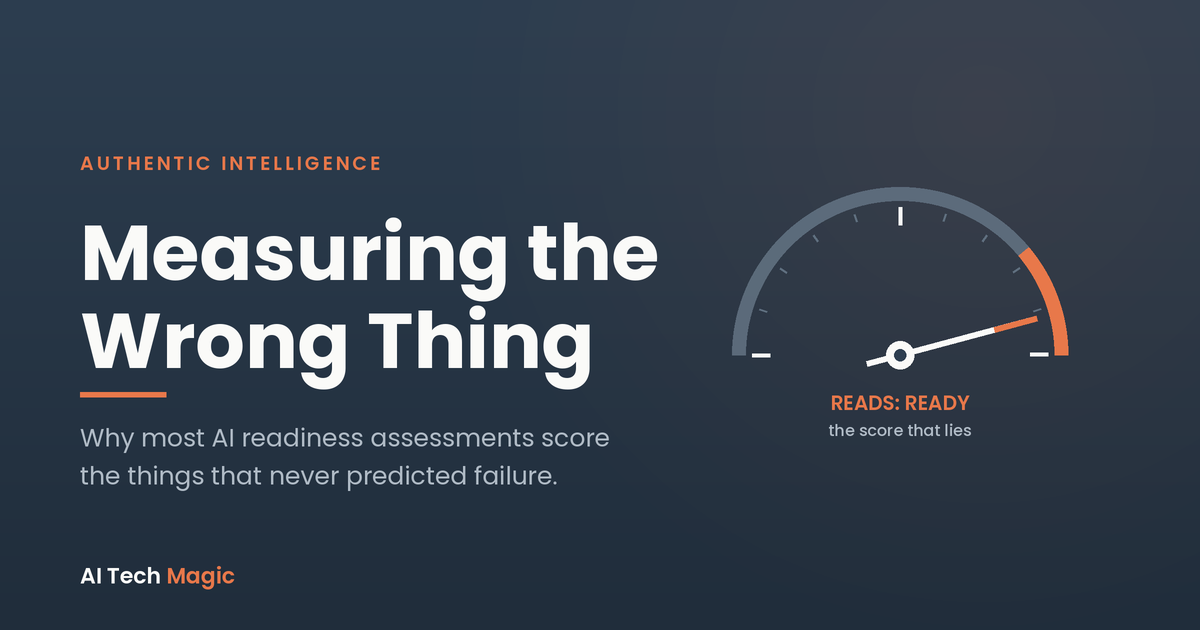
A maturity score that says you are "Level 3, approaching maturity" is comfortable, and mostly useless. Most AI readiness assessments fail for a simple reason: they measure what you have, not whether your core workflows are actually ready to be automated.
A leadership team I spoke with last year had done everything the playbook asked. They had an AI strategy on a slide, a data lake in place, a head of AI hired. A vendor assessment delivered a tidy verdict: Level 3 of 5, approaching maturity. Everyone in the room felt good about that number.
Six months later, their flagship pilot was quietly shelved. The model worked in the demo and fell apart the moment it touched real data and real users.
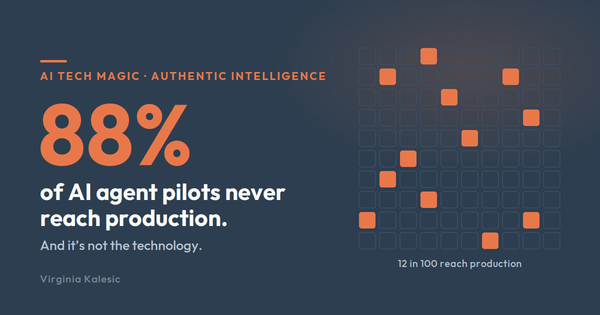
This pattern is not unusual.
The gap is a different kind of readiness, and it is the kind these assessments rarely test.
Here is the part that should bother you: the assessment that labeled them "approaching maturity" never tested the thing that actually killed the pilot. It measured the wrong variables and gave the wrong signal.
Most assessments count what you have, not what you can do
Walk through a typical AI readiness questionnaire and notice what it asks. Do you have a documented strategy? A data pipeline? An executive sponsor? How many employees have access to AI tools?
These are inputs. They are things you can buy, assign, or check off.
The problem is that you can have all of them and still produce nothing. An organization can score highly on strategy, governance, and tooling while delivering zero business impact. The assessment confirms the ingredients are in the kitchen. It says nothing about whether anyone can cook.
That is the flaw. A score built on inputs feels rigorous because it produces a number. In reality, it is closer to a record of your purchasing and org design decisions than a prediction of whether your next AI initiative will ship.
The questionnaire is often a sales instrument
There is a quieter issue underneath this input bias. Many readiness assessments are created by vendors, and the questions tend to highlight exactly the gaps their products are designed to fill.
Score low on observability from a company that sells observability tooling, and the recommended next step will not be surprising.
This is why so many of these exercises feel performative. They generate activity, a polished deck, and a maturity score for leadership updates. They rarely surface insights the team did not already suspect. More importantly, there is little evidence that completing one meaningfully improves the odds of shipping successful AI systems.
A readiness score should be a starting signal. The moment it becomes a KPI to optimize, it stops telling you the truth.
The pillar they skip is the one that matters
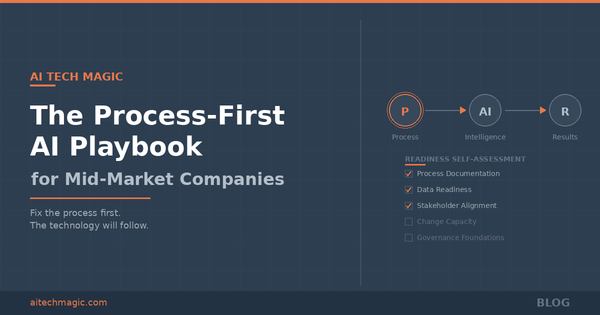
What most frameworks fail to evaluate seriously is process readiness. Not whether a process diagram exists somewhere, but whether the specific workflow you want AI to touch is consistent, understood, and worth automating.
This is where initiatives actually break.
If three teams execute the same workflow three different ways, your model has no stable target. If exceptions are undocumented, the system will learn the happy path and fail in production. If the process itself is unstable, automation simply accelerates inconsistency.
I have seen this across manufacturing, medtech, and enterprise software. Strong technology paired with weak process kills more AI initiatives than any tooling gap.
You can check every box on a maturity model and still point a sophisticated system at a broken workflow. The result is a broken process that runs faster, with a larger bill attached.
This is why process comes before technology. It is also the layer most scoring frameworks cannot see, because it does not show up in counts of tools, licenses, or committees. It only shows up when you ask a harder question: if we automated this workflow tomorrow, what would actually happen?
What a real readiness check tells you
A useful assessment does not hand you a level. It hands you a decision and a short list of constraints.
The decision is simple and uncomfortable: can you ship something that survives production in the next ninety days, yes or no?
If the answer is no, the value is in the specificity of why.
A real diagnosis does not say "improve data quality." It tells you which datasets are usable, which are locked behind systems without interfaces, and which break under real-world conditions. It identifies which team can execute now, which needs targeted training, and which workflow is not yet stable enough to automate.
In practice, this comes down to a few concrete checks:
- Is the workflow documented and consistently executed?
- Does production data reflect reality, not just curated samples?
- Is there clear ownership for shipping and maintaining the system?
- What happens when the system is wrong?
You leave with the next three things to fix, in order. Not a score to report upward.
You can own every tool on the maturity checklist and still automate a broken process. That is expensive momentum in the wrong direction, and no score will warn you.
Where scoring actually helps
None of this means readiness scores are useless. A fast, honest snapshot can be a good way to start a conversation. It can frame what is realistic now versus what is a year away.
The mistake is treating the number as the outcome instead of the entry point.
When I assess an organization, the tier it lands in, whether that is AI Dormant, AI Awakening, or AI Accelerating, is the first sentence, not the conclusion. It provides context. The value comes from what follows: process diagnosis, sequencing, and an honest read on which pilots are worth running.
If your last assessment left you with a level and a sense of progress, you were given a snapshot of what you have built. What you actually need is a prediction of what will survive production.
Ask a different question: if we automated this workflow tomorrow, what would happen? The answer to that question is the only readiness signal that has ever reliably predicted success.
Get an honest read, not a vanity score.
ReadinessRadar gives you a fast, candid snapshot of where your organization actually stands, and points you at the gaps worth closing first.
Take the Assessment