
The Process-First AI Playbook for Mid-Market Companies
AI doesn't fix broken processes — it accelerates them. A practical playbook and self-assessment for mid-market companies ready to get AI right the first time.
Most AI initiatives don't fail because of the technology. They fail because organizations automate broken processes — and then wonder why they got expensive chaos instead of transformation.
I've watched it happen more times than I can count. A VP gets back from a conference buzzing about AI. The team spins up a pilot. Three months later, they have a working proof-of-concept. Six months after that, the program stalls. The board starts asking uncomfortable questions about ROI, and the whole initiative quietly gets shelved.
The technology worked fine. The process underneath it was the problem.
After leading AI/ML teams at Fortune 500 scale — managing global teams, multi-million dollar budgets, and deployments that had to actually move business metrics — I've learned one thing that separates organizations that get real value from AI from those that don't: the ones that win fix their processes first.
This isn't a popular opinion in a market flooded with "just plug in AI" messaging. But if you're a mid-market leader with 200 to 2,000 employees and limited margin for expensive mistakes, it might be the most important thing you read this year.
The Expensive Mistake Nobody Talks About
Here's the pattern I see constantly. An organization identifies a workflow that's slow, error-prone, or expensive — say, their quote-to-order process. Someone suggests AI could speed it up. A vendor demo looks promising. The team moves forward.
But here's what they didn't examine first: the quote-to-order process itself is a mess. Three different teams touch it. There are four undocumented exceptions that only two people understand. The data feeding it lives in spreadsheets that get emailed around every Friday.
Layering AI on top of that doesn't create transformation. It creates automated chaos — the same broken process, just running faster and with less human oversight to catch the problems.
The cost isn't just the technology spend. It's the 6 to 12 months of opportunity cost you burn before realizing the foundation wasn't ready.
Process Reimagination vs. Process Automation
This distinction is everything, and most organizations miss it entirely.
Process Automation takes your existing workflow and makes it faster. If the workflow is sound, this works beautifully. If it's not, you've just turbocharged your problems.
Process Reimagination asks a different question: Given what AI can now do, what should this process look like if we were designing it from scratch?
Think of it as a simple matrix:
- High process maturity + AI = Transformation. Your processes are standardized, documented, and data-rich. AI amplifies what's already working. This is where the magic happens.
- Low process maturity + AI = Expensive chaos. Your processes are inconsistent, undocumented, or dependent on tribal knowledge. AI amplifies the dysfunction. This is where budgets go to die.
Most mid-market companies fall somewhere in between — and that's okay. The key is knowing where you fall before you start writing checks.
What "Process First" Looks Like in Practice
Let me walk you through a generalized example I've seen play out across multiple industries.
The scenario: A mid-market manufacturer wants to use AI to improve their quote-to-order cycle time.
What most companies do: Jump straight to an AI tool that auto-generates quotes based on historical data. It works in the demo. It struggles in production because the historical data is riddled with one-off exceptions, the pricing logic lives in a senior rep's head, and three departments have different definitions of "standard order."
What process-first companies do:
Step 1 — Standardize. Before touching any AI tool, they map the actual workflow (not the one in the SOP that nobody follows). They identify the four exception paths, document the pricing logic, and align all three departments on definitions.
Step 2 — Clean. They address the data quality issues. They reconcile the spreadsheets, establish a single source of truth, and create governance around how data gets entered going forward.
Step 3 — Reimagine. Now — with clean processes and clean data — they ask: what should this workflow look like with AI in the loop? Maybe AI handles the 70% of standard quotes automatically, routes the 20% of complex quotes to the right specialist with pre-populated context, and flags the 10% that need executive review.
Step 4 — Implement. The AI deployment is almost boring at this point. The hard work was in steps one through three. But the results are transformative — and they stick.
The difference in outcomes is staggering. The first approach typically delivers a pilot that demos well but never scales. The second approach delivers compounding value, because every future AI initiative benefits from the process foundation you've already built.
The Mid-Market Advantage (Yes, Really)
Here's something enterprise companies won't tell you: being mid-market is actually an advantage when it comes to process-first AI.
At enterprise scale, process standardization is a multi-year, multi-million dollar initiative involving dozens of stakeholders, legacy systems, and organizational politics that would make a diplomat weep. I've lived it. It's painful.
At mid-market scale — 200 to 2,000 employees — you can move faster. Your processes are complex enough to benefit from AI, but not so entrenched that changing them requires an act of Congress. You can get your key decision-makers in one room. You can pilot a process change in weeks, not quarters.
The challenge is that mid-market companies often don't have the frameworks to do this systematically. Enterprise companies have armies of consultants. Startups move fast enough to figure it out as they go. Mid-market companies need something in between: enterprise-grade strategy at a pace and price point that makes sense.
The Self-Assessment: Is Your Organization Ready?
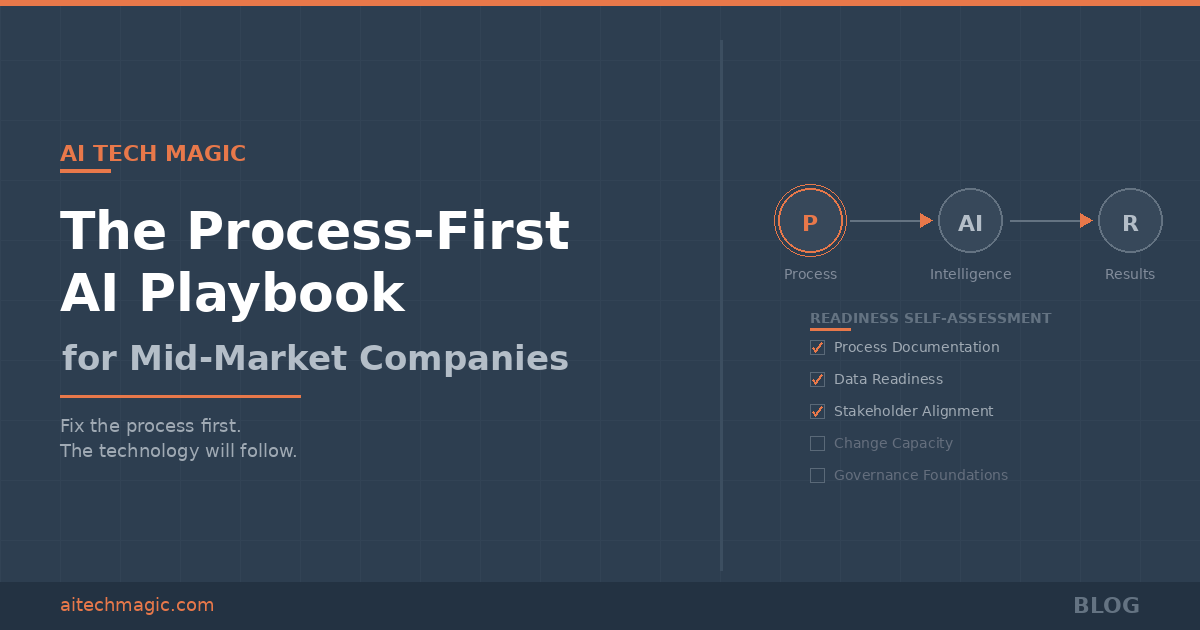
Before you invest a dollar in AI, answer these five questions honestly. Score each one from 1 (not at all) to 5 (absolutely).
1. Process Documentation Are your core business processes documented, current, and actually followed by the people doing the work? (Not the SOPs from 2019 that live in a SharePoint folder nobody opens.)
2. Data Readiness Is the data that would feed your AI initiative clean, centralized, and governed? Do you have a single source of truth, or are critical decisions being made from emailed spreadsheets?
3. Stakeholder Alignment Do your executive team, department heads, and frontline teams share a common understanding of what AI should accomplish and what success looks like? Or does every leader have a different vision?
4. Change Capacity Has your organization successfully adopted a major process or technology change in the last two years? Do you have the change management muscle to support an AI initiative?
5. Governance Foundations Do you have clear ownership, accountability structures, and decision-making frameworks for technology initiatives? Does someone own AI strategy, or is it everyone's side project?
Scoring:
- 20–25: You're ready. Your foundation is solid. AI initiatives will likely deliver real value. Focus on identifying the highest-impact use cases and move forward with confidence.
- 14–19: You're close. You have strong foundations in some areas but gaps in others. Address the gaps first — it'll take weeks, not months — and your AI investments will perform dramatically better.
- 8–13: Process first. You'll get significantly more value by investing in process maturity before investing in AI technology. This isn't a setback — it's the smartest move you can make.
- 5–7: Start with the basics. You have foundational work to do, but that's not a bad thing. Many of the most successful AI programs I've seen started here. The key is having the discipline to build the foundation before chasing the shiny technology.
What To Do Next
If you scored below 20, resist the urge to skip ahead to the technology. I know the pressure is real — your board is asking about AI, your competitors are making announcements, and every vendor in your inbox has a demo that looks incredible.
But the companies that win with AI aren't the ones that moved fastest. They're the ones that moved smartest. They built the process foundation first, and everything else compounded from there.
Here's where to start:
This week: Pick one business process you've been considering for AI. Map how it actually works today — not how it's supposed to work, but how it actually runs, including the workarounds and exceptions.
This month: Run the self-assessment above with your leadership team. Be brutally honest. The gaps you identify aren't problems — they're your roadmap.
This quarter: Address the top two gaps before engaging any AI vendor. You'll negotiate better, implement faster, and get dramatically better results.
If you want a structured approach to this, that's exactly what I built the AI Readiness Diagnostic to do — a comprehensive evaluation of where your organization stands across all five dimensions, with a concrete action plan tailored to your specific situation. No vendor pitches, no 200-page reports that gather dust. Just clear-eyed assessment and a practical path forward.
The companies that get AI right in 2026 won't be the ones with the biggest budgets. They'll be the ones with the strongest foundations.
Start with the process. The technology will follow.
Virginia is the founder of AI Tech Magic, where she helps mid-market companies implement AI strategy that actually works. She leads AI/ML teams at Fortune 500 scale and holds a Cornell AI/ML certification. Connect with her on LinkedIn.